Flowers Brushes Procreate: A Practical Evaluation for Designers
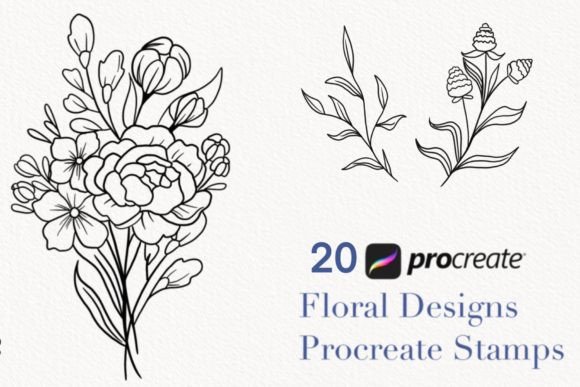
In the digital design landscape, the distinction between a generic asset pack and a genuinely useful toolkit often lies in specificity and organization. The Flowers Brushes Procreate set, specifically the Botanical Stamps collection, addresses a common friction point for illustrators and graphic designers: the need for high-quality, pre-rendered botanical elements that integrate seamlessly into complex workflows. Unlike traditional brushes that require manual drawing of every leaf or petal, this brushset functions as a library of stamps, offering immediate access to a vast array of leaves, branches, flowers, and floral bouquets. For professionals managing tight deadlines or hobbyists seeking to elevate their surface pattern designs without mastering advanced illustration techniques, this resource presents a compelling case study in efficiency versus creative control.
The Mechanics of Botanical Stamp Brushes
At its core, this tool operates on the principle of stamping rather than painting. When you select a specific brush from the Flowers Brushes Procreate palette, you are not loading a texture that reacts to pressure in real-time; instead, you are activating a pre-drawn vector or raster image. This fundamental difference dictates how the tool is used. The primary advantage is consistency. A hand-drawn flower might vary slightly with each stroke, which can be charming but problematic when creating a repeating pattern where uniformity is required. With these botanical stamps, the first instance of a rose or fern is identical to the hundredth, ensuring visual coherence across large-scale projects like fabric prints or wallpaper designs.
The inclusion of proper labeling within the brush settings is a critical feature that significantly enhances usability. In many asset libraries, users must cycle through dozens of thumbnails to find a specific element, wasting valuable time. Here, the labels allow for rapid identification. Whether you need a "Monstera leaf" or a "wildflower bouquet," the ability to locate the exact asset instantly streamlines the creative process. This organizational structure suggests that the creator understands the workflow of professional designers who prioritize speed and precision over discovery-based exploration.
Integration into Professional Workflows
The true value of the Flowers Brushes Procreate set becomes apparent when applied to real-world scenarios. Consider the workflow of a brand designer tasked with creating a logo for an organic skincare line. The brief requires natural, elegant botanical imagery. Instead of spending hours sketching and refining a custom illustration, the designer can utilize the stamp brushes to assemble a composition. They can layer different branches and flowers, adjusting opacity and blend modes to create depth. While the base assets are static, the flexibility comes from how they are combined. This approach allows for rapid prototyping, enabling the designer to present multiple concept variations to a client within a single session.
Similarly, in surface pattern design, the utility of these stamps is substantial. Creating seamless patterns manually is a labor-intensive process involving complex tiling calculations. By using the Flowers Brushes Procreate set, a designer can scatter various botanical elements across a canvas, then use Procreate's built-in pattern tools to generate a repeat. The variety included—ranging from simple single leaves to complex bouquets—provides enough diversity to prevent the pattern from looking repetitive or robotic. The key to success here is not just the assets themselves, but the user's ability to manipulate scale, rotation, and color to break the "stamped" look and achieve a more organic feel.
Quality and Consistency Analysis
Evaluating the quality of digital assets requires looking beyond the thumbnail preview. The illustrations in this botanical set demonstrate a high level of detail, with clean edges and defined textures that hold up well even when scaled down for small applications like stickers or iconography. The line work appears consistent, avoiding the jagged artifacts that sometimes plague lower-resolution stamp brushes. This reliability is essential for print production, where pixelation or blurriness can ruin a final product. For entrepreneurs producing merchandise such as t-shirts or greeting cards, the assurance that the graphics will render crisply at 300 DPI is a non-negotiable requirement.
However, it is important to acknowledge the limitations inherent in stamp-based tools. Because the images are pre-defined, they lack the fluidity of a hand-painted stroke. If a project demands a highly unique, expressive style that mimics the imperfections of watercolor or ink wash, these brushes may feel too rigid. They are best suited for styles that lean towards line art, flat illustration, or structured botanical diagrams. Users expecting the dynamic variation of a wet-on-wet paint simulation will likely find the results too uniform. Therefore, the Flowers Brushes Procreate set is most effective when paired with other tools that add texture and movement, rather than being used in isolation.
Flexibility Across Diverse Projects
The versatility of this brushset extends across a wide spectrum of creative industries. For educators creating visual aids or botanical guides, the labeled nature of the illustrations ensures accuracy in representation. A teacher can quickly pull up a specific type of branch or flower to illustrate a lesson on plant anatomy without needing to source external clipart that may be low resolution or poorly styled. For bloggers and publishers, these assets offer a quick way to enhance articles about gardening, sustainability, or interior design with custom-looking graphics that maintain a cohesive aesthetic throughout a publication.
Small business owners leveraging platforms like Etsy or Shopify can also benefit significantly. The ability to rapidly produce sticker sheets, packaging designs, or social media graphics gives them a competitive edge. The variety of floral bouquets included allows for the creation of seasonal collections—think spring wildflowers or autumn foliage—without reinventing the wheel for every holiday. The efficiency gained translates directly to the bottom line, allowing creators to focus more on marketing and less on the tedious execution of basic illustration tasks.
Strategic Recommendations for Implementation
To maximize the effectiveness of the Flowers Brushes Procreate collection, users should adopt a strategy of modification and combination. Relying solely on the default appearance of the stamps can lead to designs that look generic. A practical recommendation is to alter the hue of the assets to match a specific brand palette. Procreate's color adjustment features allow for easy recoloring, turning a standard green leaf into a vibrant coral or deep navy element. Additionally, masking and clipping masks can be used to crop portions of the stamps, integrating them into backgrounds or other shapes in ways that defy their original boundaries.
Another strategic approach involves layering. By stacking multiple stamps with varying opacities, designers can create depth and shadow, simulating a three-dimensional effect. This technique is particularly useful for logo design, where a flat icon might lack impact. Using a darker shade of the same botanical stamp slightly offset behind the main image can provide a subtle drop shadow or highlight, adding sophistication to the final output. However, users must remain mindful of file size and complexity; overusing high-resolution stamps can bloat project files, potentially slowing down performance on older tablets.
Who Should Invest in This Tool?
The Flowers Brushes Procreate set is not a one-size-fits-all solution, but it is an invaluable asset for a specific demographic. It is ideally suited for professionals who need to balance speed with quality, such as freelance illustrators working under tight deadlines, marketing agencies producing seasonal campaigns, and surface pattern designers building extensive libraries. Serious hobbyists who wish to create professional-grade greeting cards or home decor items will also find the learning curve manageable and the results rewarding.
Conversely, artists whose primary goal is to practice and refine their freehand drawing skills might find this tool counterproductive. If the objective is to learn how to draw a perfect lily from scratch, relying on a stamp defeats the purpose of skill acquisition. Similarly, those working exclusively in photorealistic 3D rendering may find these 2D vector-style assets incompatible with their pipeline. Ultimately, the decision to incorporate this brushset into a workflow depends on the specific goals of the project. For those prioritizing efficiency, consistency, and the rapid assembly of botanical motifs, it offers a robust and reliable solution that stands out in a crowded market of digital assets.